IYR: Rates Are A Headwind For Real Estate (NYSEARCA:IYR)
mikulas1/E+ via Getty Images
investment thesis
REITs often pay substantial dividends and have the potential for moderate long-term capital gains. As a result, they are frequently seen by investors as a safe source of revenue and an inflation hedge. REITs generally achieve their returns through the use of leverage, which makes them vulnerable to changes in interest rates. In a rising-rate environment such as we have nowadays, higher interest rates tend to decrease the value of properties and increase REIT borrowing costs. As a result, the benefits of investing in REITs are skewed to the downside in my opinion. In this article, I will review the iShares US Real Estate ETF (NYSEARCA:IYR), which provides exposure to a diversified basket of US REITs.
strategy detail
The iShares US Real Estate ETF tracks the investment results of the Dow Jones US Real Estate Capped index. This fund provides exposure to US real estate companies and REITs, which invest in real estate directly and trade like stocks. This ETF is generally used for diversification purposes, to seek income, or to express a sector view.
If you want to learn more about the strategy, please click here.
portfolio composition
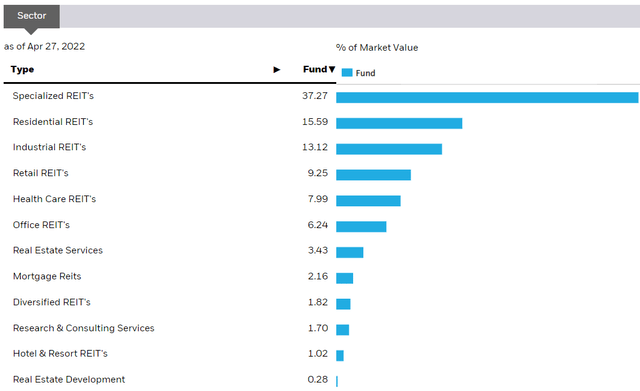
The index places a high weight on Specialized REITs (representing around 37% of the index), followed by Residential REITs (accounting for 16% of the index) and Industrial REITs (representing around 13% of the fund). The largest three sectors have a combined allocation of approximately 66%. I personally like the fact that the allocation to highly cyclical properties (such as industrial, retail, and mortgage REITs) doesn’t exceed 50% of the total assets. In terms of geographical allocation, IYR invests exclusively in the US
iShares
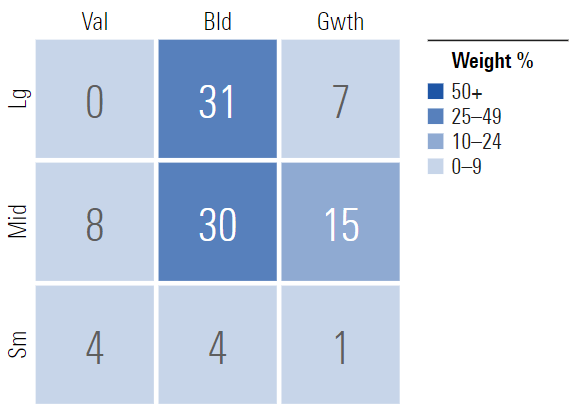
31% of the portfolio is invested into large-cap blend issuers, characterized as large-sized companies where neither growth nor value characteristics predominate. Large-cap issuers are generally defined as companies with a market capitalization above $8 billion. The second-largest category is mid-cap blend equities. It is interesting to see that IYR allocates ~62% of the funds to mid and small-cap issuers which generally have a larger runway to compound than large-cap issuers. That said, these stocks generally have a higher beta, which makes them more volatile compared to the market. I think it is important to see if you are comfortable with a higher level of volatility before purchasing IYR.
Morningstar
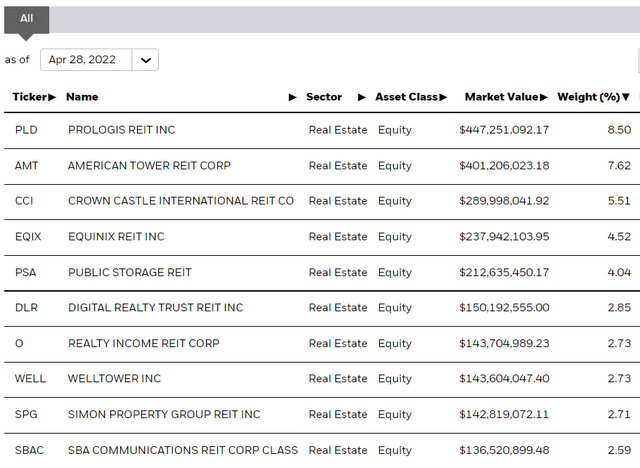
The fund is currently invested in 86 different stocks. The top ten holdings account for 44% of the portfolio, with no single stock weighting more than 9%. The fund is concentrated in a few stocks which are likely to drive future returns. If you are looking for more diversification, the Global X SuperDividend REIT ETF (SRET) could be an interesting alternative, even if it also invests in countries outside North America.
iShares
Since we are dealing with equities, one important characteristic is the portfolio’s valuation. According to data from iShares, the fund currently trades at an average price-to-book ratio of 3.1 and an average price-to-cash flow of ~20. A multiple of 20x free cash flow seems a bit high in my opinion for real estate, which is ultimately a cyclical asset. Moreover, if we compare it to a plain vanilla S&P 500 ETF which trades at 15x cash flow, I do not see any real advantage for owning IYR, apart from the slightly higher dividend yield.
Is This ETF Right for Me?
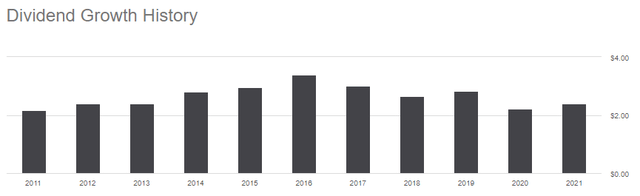
IYR has a distribution yield of ~2.2%. Given the low yield, I don’t think the rewards compensate shareholders enough for holding a long position in this ETF. Additionally, you should keep an eye on the dividend growth history, which clearly shows a negative trend since 2016. As a dividend investor, the last thing you want is your monthly dividend payment to start shrinking.
Seeking Alpha
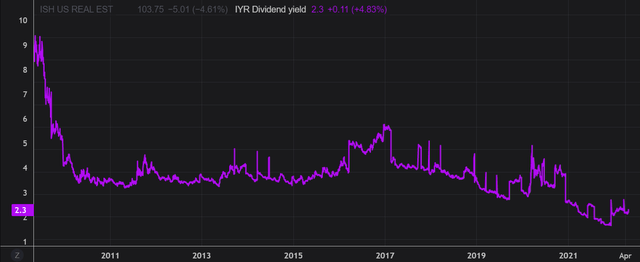
If you focus on valuation by looking at the dividend yield, it is worth noting that IYR has only been more expensive once in its entire history. In other words, IYR’s dividend yield was almost always higher than it is today. As a result, I would personally wait for an entry point where the yield gets attractive.
Definitely Eikon
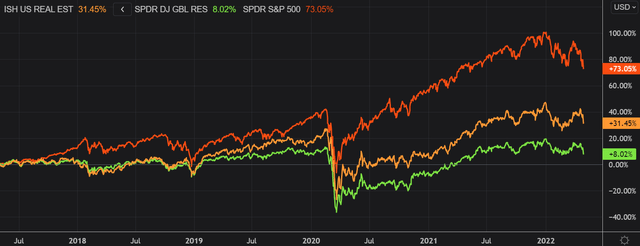
I have compared below IYR’s price performance against the performance of the SPDR DJ Wilshire Global Real Estate ETF (RWO) and the SPDR S&P 500 Trust ETF (SPY) over the last 5 years to assess which one was a better investment. Over that period, SPY clearly underperformed both real estate strategies. However, I think it is interesting to note that IYR did better than the global real estate strategy over that period. To put IYR’s performance into perspective, a $100 investment 5 years ago into this ETF would now be worth ~$131.45. This represents a compound annual growth rate of 5.6% excluding dividends, which is an average absolute return.
Definitely Eikon
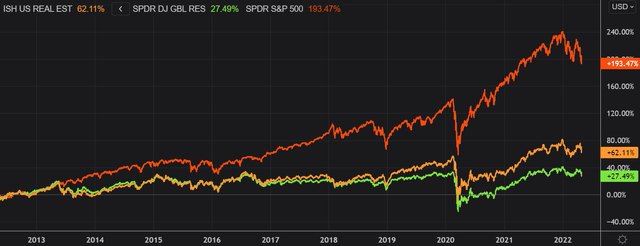
If we take a step back and look at the performance from a 10-year perspective, the results don’t change much. SPY came on top once again, followed by IYR.
Definitely Eikon
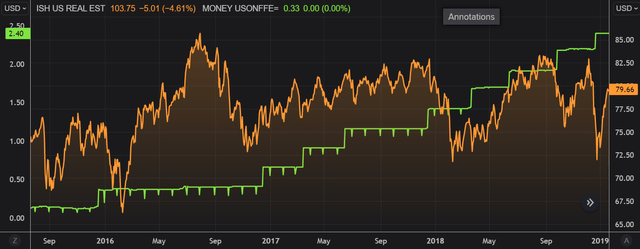
At the moment, however, the biggest elephant in the room in my opinion is related to how well this ETF will perform in a rising interest rate environment. If we go back to the previous hiking cycle that started in 2015 and ended in 2019, it is worth noting that IYR generated a 10% return, excluding dividends, while volatility was pretty high. I believe the hiking cycle that started in 2022 will be more aggressive than what we experienced seven years ago, which makes me think that IYR will likely underperform the market once again.
Definitely Eikon
Key takeaways
IYR provides exposure to a diversified basket of US REITs. The fund currently has one of its lowest dividend yields since inception, which makes it overvalued in my opinion, especially when you take into account that dividend payments have been on a negative trend since 2016. If we look at the macro picture, rates in the US are expected to rise going forward. The last time we had a tightening cycle back in 2015-2019 coincided with a lackluster performance for IYR’s shareholders. Given the reason mentioned above, I think IYR doesn’t offer an appealing risk-reward opportunity at the moment.