Kelowna home prices will likely drop a total of 15%
The worst of the price slashing is likely over in Kelowna’s confusing and rapidly changing housing market.
The ReMax Fall Canadian Housing Market Outlook pegs the average residential sale price in Kelowna as of Aug. 31 at $933,112, an 11% tumble from its peak of $1,050,000 in February.
11% represents a significant $116,888 price drop.
And it’s probably not finished falling, according to Kelowna-based ReMax Canada executive vice-president Elton Ash.
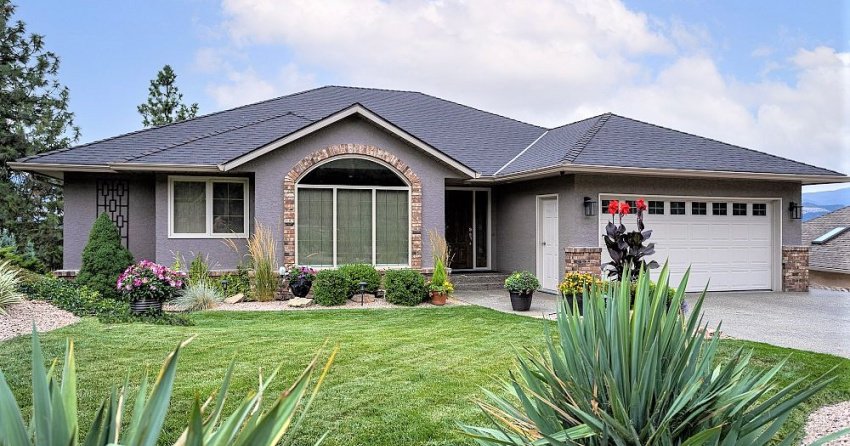
The ReMax Fall Canadian Housing Market Outlook puts the average residential sale price in Kelowna on Aug. 31 at $933,112, down from its record high of $1,050,000 in February.” class=”img-responsive” src=”https://www.kelownanow .com/files/files/images/%241_13%20m%20home(1).JPG” style=”margin: 5px;”/>
For its outlook, ReMax compiles the average residential sale price by lumping in all sales of single-family homes, townhouses and condominiums.
The Association of Interior realtors breaks out benchmark selling prices of the three categories of housing.
The association’s benchmark in August for a typical single-family home was $1,018,000 down from the record of $1,132,000 in April, a townhouse $772,7000 from $829,000 and a condo $526,700 from $557,700.
The mortgage interest rate hikes and runaway inflation that set off price drops, also prompted a substantial slowdown in sales.
The outlook shows there were 3,568 home sales in Kelowna Jan 1 to Aug 31 this year, a 32% dive from the 5,227 sales over the same period last year.
“The market will pick up again, likely in mid-2023,” said Ash.
“But in the meantime, there will be a flattening out through the fall and the winter.”
Current mortgage interest rates at 5% for a five-year, fixed term are scary considering they were as low as 1.9%.
However, that’s also relative.
A 5% rate would have made people ecstatic in the 1980s when mortgage interest rates climbed as high as 20% amid a fierce recession.
“We don’t have a recession now. What we have is unusual times where the Bank of Canada is making oversized increases that scare people in an effort to curb inflation,” said Ash.
“But interest rates are still historically lower. And Kelowna’s housing market is still historically good.”
Kelowna’s economy is still strong, employment is high and people are moving to the city from elsewhere in the province, country and world.
“That all means there will be demand for housing and we don’t have a lot of supply, so sales and prices will begin to go up eventually,” Ash summed up.
Support local journalism by clicking here to make a one-time contribution or by subscribing for a small monthly fee. We appreciate your consideration and any contribution you can provide.