Automotive Properties Real Estate Investment Trust’s (TSE:APR.UN) 11% CAGR outpaced the company’s earnings growth over the same five-year period
If you buy and hold a stock for many years, you’d hope to be making a profit. Better yet, you’d like to see the share price move up more than the market average. but Automotive Properties Real Estate Investment Trust (TSE:APR.UN) has fallen short of that second goal, with a share price rise of 16% over five years, which is below the market return. But if you include dividends then the return is market-beating. Unfortunately the share price is down 8.4% in the last year.
Since it’s been a strong week for Automotive Properties Real Estate Investment Trust shareholders, let’s have a look at the trend of the longer term fundamentals.
View our latest analysis for Automotive Properties Real Estate Investment Trust
There is no denying that markets are sometimes efficient, but prices do not always reflect underlying business performance. One imperfect but simple way to consider how the market perception of a company has shifted is to compare the change in earnings per share (EPS) with the share price movement.
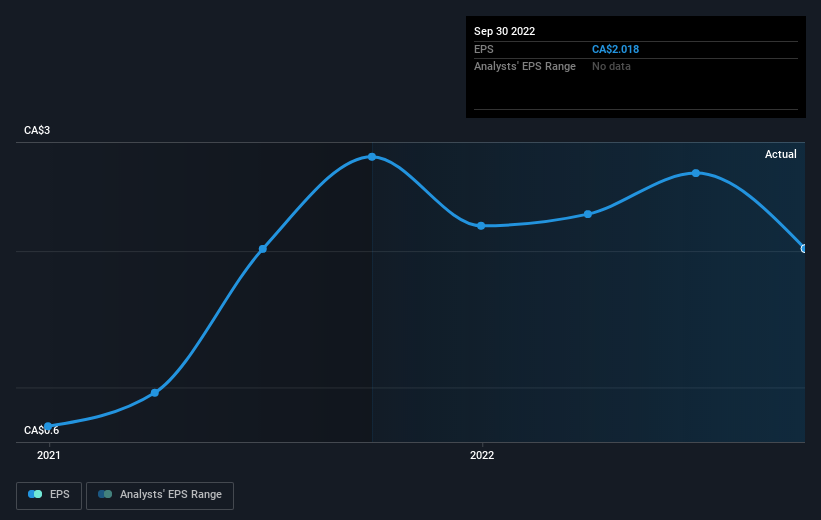
During five years of share price growth, Automotive Properties Real Estate Investment Trust achieved compound earnings per share (EPS) growth of 5.3% per year. This EPS growth is higher than the 3% average annual increase in the share price. So it seems the market isn’t so enthusiastic about the stock these days. This cautious sentiment is reflected in its (fairly low) P/E ratio of 6.25.
You can see below how EPS has changed over time (discover the exact values by clicking on the image).
earnings-per-share-growth
We know that Automotive Properties Real Estate Investment Trust has improved its bottom line over the last three years, but what does the future have in store? It might be well worth while taking a look at our free report on how its financial position has changed over time.
What About Dividends?
As well as measuring the share price return, investors should also consider the total shareholder return (TSR). Whereas the share price return only reflects the change in the share price, the TSR includes the value of dividends (assuming they were reinvested) and the benefit of any discounted capital raising or spin-off. Arguably, the TSR gives a more comprehensive picture of the return generated by a stock. As it happens, Automotive Properties Real Estate Investment Trust’s TSR for the last 5 years was 66%, which exceeds the share price return mentioned earlier. And there’s no prize for guessing that the dividend payments largely explain the divergence!
Story continues
A Different Perspective
While it’s certainly disappointing to see that Automotive Properties Real Estate Investment Trust shares lost 2.2% throughout the year, that wasn’t as bad as the market loss of 3.0%. Longer term investors wouldn’t be so upset, since they would have made 11%, each year, over five years. It could be that the business is just facing some short term problems, but shareholders should keep a close eye on the fundamentals. I find it very interesting to look at share price over the long term as a proxy for business performance. But to truly gain insight, we need to consider other information, too. To that end, you should learn about the 3 warning signs we’ve spotted with Automotive Properties Real Estate Investment Trust (including 1 which doesn’t sit too well with us) .
We will like Automotive Properties Real Estate Investment Trust better if we see some big insider buys. While we wait, check out this free list of growing companies with considerable, recent, insider buying.
Please note, the market returns quoted in this article reflect the market weighted average returns of stocks that currently trade on CA exchanges.
Have feedback on this article? Concerned about the content? get in touch with us directly. Alternatively, email editorial-team (at) simplywallst.com.
This article by Simply Wall St is general in nature. We provide commentary based on historical data and analyst forecasts only using an unbiased methodology and our articles are not intended to be financial advice. It does not constitute a recommendation to buy or sell any stock, and does not take account of your objectives, or your financial situation. We aim to bring you long-term focused analysis driven by fundamental data. Note that our analysis may not factor in the latest price-sensitive company announcements or qualitative material. Simply Wall St has no position in any stocks mentioned.
Join A Paid User Research Session
You’ll receive a US$30 Amazon Gift card for 1 hour of your time while helping us build better investing tools for the individual investors like yourself. Sign up here