Build to rent’s glitzy goldrush raises fears for social housing | Commercial property
The Keel, a converted former HMRC office building overlooking Liverpool’s waterfront, is being touted as a solution to dull, impersonal rental housing. Tenants in the block of 240 new apartments can fake a sun-kissed glow on video calls by dialing in from its new “zoom room.” According to interior designer Jasper Sanders, the effect created by the tinted windows is a friendly nod to many Liverpudlers’ love of a year-round tan.
In the Wembley Park development in north west London, tenants can work in retro motorhomes or purpose built sheds for working from home.
Welcome to the fast-growing world of Build to Rent, an asset class that is shaking up the housing market, luring tenants with promises of more professional management than individual private landlords, and sucking in a flood of funds from banks. pension funds and even retailer John Lewis. Lured by the prospect of stable returns, these blocs are developed, owned and operated by large companies with deep pockets.
Still, there is growing unease about the boom in this new class of rental properties and concerns that the poorest in society are becoming overpriced.
Rob Wall, a 34-year-old communications trainer, moved to Wembley Park, the UK’s largest rental complex, lured by the perks.
graph
In return for pet-friendly but small apartments that come with communal benefits like access to the gym and a cinema room, tenants are parting with rent starting at £1,770 a month (plus utilities of around £200 a month).
Developer Quintain’s no-worries package meant Wall no longer had to sort out its own utilities or arrange for repairs. “We don’t have to deal with it too much,” he says. “As a drummer and football fan, being next to the SSE arena and stadium is a real bonus.”
Sports and leisure facilities are offered at Wembley Park Development.
Institutional property ownership is relatively new to the UK, but the sector is booming as house prices soar and the prospect of buying a home is becoming increasingly unaffordable for many. Build-to-rent now accounts for 20% of all new housing in England, a figure rising to 40% in London, according to research consultancy Molior. Research by property agency Ascend Properties shows that building permit requests for rental properties across the UK have risen by 52% during the pandemic.
“Residential real estate was not considered a sustainable asset class for a long time; It’s really messy to manage, with huge running costs,” said Frances Brill, a geographer at the University of Cambridge who specializes in build-to-rent.
But with interest rates so low, commercial property yields shaky and the UK facing a chronic housing shortage, it had become an attractive bet. “Investors sense that if you’re able to offer quality housing, you can make money,” she said.
Established players such as US developer Greystar – which partnered with Abu Dhabi last month to build £2.2bn of rental housing in London – have led the charge. Macquarie, the Australian bank that has paid out huge dividends while owning Thames Water, has set up a rental business with Goodstone Living. The US private equity giant KKR is financing 4,000 luxury properties. High street names like John Lewis, Lloyds Bank and Legal & General (L&G) are also joining the gold rush. Lloyds plans to own 50,000 homes within a decade, according to a strategy devised by new boss Charlie Nunn, the Financial Times reports.
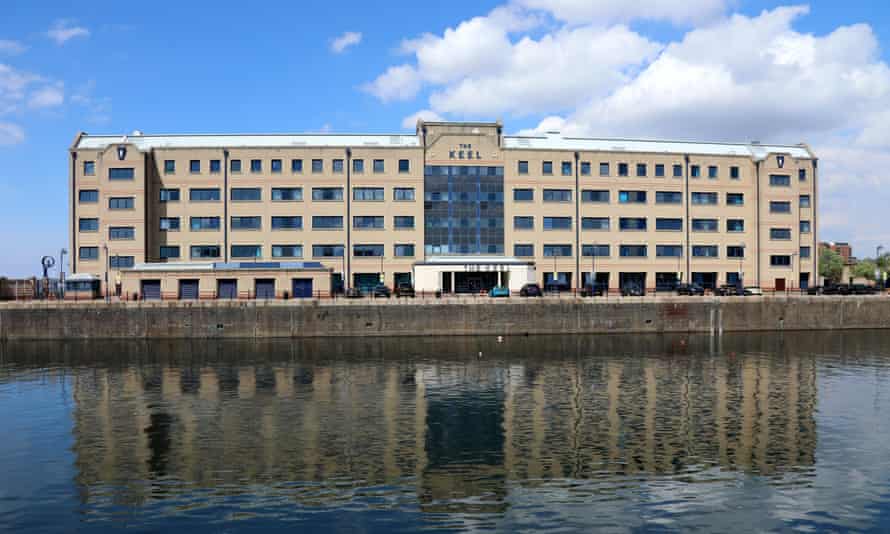 The Keel houses 240 apartments on Liverpool’s waterfront. Photo: Jackie Ellis/Alamy
According to property advisor CBRE, investors poured a record £4.1bn into the sector last year. The boom will continue as demand for rental housing outstrips supply. In Leeds, L&G Tower Works is converting the listed former factory in the city center into 245 rental apartments. Developers are also eyeing the suburban areas, building pet-friendly, larger homes designed to encourage longer-term contracts. L&G has announced a project of 117 apartments in Peterborough for families looking for properties outside the city with office space and gardens.
Experts say that while private equity firms’ interest is based on experience, the biggest advantage for pension funds is that they can increase rent roughly in line with inflation. Dan Batterton, L&G’s head of build to rent, said investors were taking about 4% of annual rental income in connection with inflation. “Housing needs make the rental market less volatile,” Batterton said.
A large pension fund cannot afford to be known as a bad landlord. No one wants to kick a grandma onto the streetFrances Brill, build-to-rent specialist
For renters, there’s the promise of well-managed homes for people who can’t afford to buy and who are fed up with rogue landlords. In the UK, almost twice as many people are looking for rented accommodation as there are places available – a ratio that has risen to 10 to 1 in Salford, according to research by insurance company Admiral.
“Especially in such a new market, a large pension fund cannot afford to be known as a bad landlord,” said Brill. “No one wants to kick a grandma out in the street.”
She sees Switzerland, where 60 percent of households rent, as a success story: Pension fund apartments are maintained there, with stable rents. “There is a glimmer of hope as to what the UK market could look like if build-to-rent lessors’ actions are sufficiently regulated.”
But not all communities can afford to shop into the lifestyle. “While build-to-rent developers are required to provide nominally ‘affordable’ housing, that doesn’t mean they’re building more public housing,” Brill said. “It doesn’t address the affordability crisis because it’s so expensive.”
 Milton, right, and his family, who live in a privately rented studio, have been on the council housing list for three years. Photo: Milton
The homeless shelter Shelter has warned that houses for rent will likely target the higher end of the market, making it unaffordable for low-income households. And while it was booming during the pandemic, affordable housing starts in England fell by 16% in 2020-21, according to government data.
In Elephant and Castle, London’s ‘Latin Quarter’, a £3bn redevelopment project, including a large chunk of the rentable building, is evicting the current number of social housing tenants. Some 4,000 public housing units have already been demolished in the area, and many residents have had to move to suburbs more than ten kilometers away.
Delancey, the property developer best known for partnering with the Kings of Qatar to buy and develop London’s former Olympic Village, will replace the shopping center with rental apartments. It has permission for 979 rental apartments, 116 of which will be social housing. His original proposal for just 33 affordable housing was rejected by the council. The block, due for completion in 2030 and just streets away from the demolished Heygate development, is a metaphor for the socio-economic tensions in the Borough of Southwark.
With 16,000 households on the waiting list for housing in Southwark, families are often pushed into overcrowded housing. Not far from the Delancey settlement, Milton, 53, his wife Cecilia, 50, and two children live in a private rented one-bedroom apartment. They have been waiting for the municipal register for a three-room apartment for three years. “It has been a very difficult time not only for me but also for my children as they translate for me and help me with the documents I am presenting to the council,” said Milton, who declined to give his full name. His children eat, sleep and do their homework in the same room.
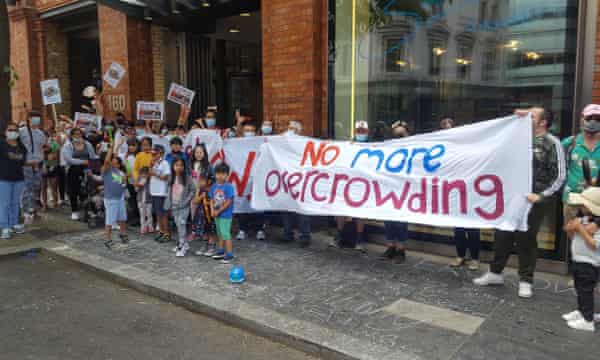 A protest organized by Housing Action Southwark and Lambeth last June. Photo: Elizabeth Wyatt
“Housing should not be an asset,” said Elizabeth Wyatt of campaign group Housing Action Southwark and Lambeth. “Good quality social housing where communities can thrive and take root should be a right.”
Southwark City Council said: “The offer of 35% affordable housing, comprising 116 social rental apartments, was the maximum we could reasonably secure for the Elephant and Castle development. We are committed to providing 2,500 new public housing units across the county by May 2022.”
Others think that these expensive developments require more refinement. “Smoke and mirrors abound with these developers,” said John, a marketing manager and resident of Hurlock Heights, a new tower in Elephant and Castle (he declined to give his full name). The building houses a mix of properties; Buildings for rent, shared ownership and houses for sale. He feels his apartment doesn’t fit in with the leafy, state-of-the-art complex in the brochure, and residents have complained about high utility bills.
“Our roof garden is in such a bad state. Because residents walk their pets there, the grass is dead,” John said. He said not being a pet owner is even more frustrating because when he originally bought the apartment, nothing in the ad or contract said pets were allowed.
There are lessons for the build-to-rent developers from other parts of Europe. In Germany, Berliners last year voted on a controversial land expropriation law to take 240,000 lots, or 11% of all apartments in Berlin, from corporate owners.