COMMENTARY: How real estate and farmland have protected investors as inflation emerges – National
More than 100 years ago, a jug of milk cost 40 cents. Today it’s almost $ 4. This phenomenon is called inflation.
In the past five decades, all industrialized nations have experienced inflation. A typical inflation rate is around two percent and indicates a stable economy.
Continue reading:
Gas prices pushed Canadian inflation up slightly in February
Although Murray Rothbard, an economic historian and political theorist of the 20th century, argues that the state’s natural tendency is inflation, it has its drawbacks. For example, if prices rise too quickly, you lose purchasing power. To that end, Milton Friedman, a Nobel Prize-winning economist, stated that inflation is taxation without legislation.
While inflation in Canada has been historically stable, it can never be fully anticipated. The COVID-19 pandemic has created unprecedented market uncertainty and economic anomalies.
The story continues under the advertisement
According to the latest data from Statistics Canada, the rate of inflation was 0.7 percent year over year. Some experts suggest that inflation is currently underestimated. The demand for essential goods and services is high because their prices are higher than average. However, the current “basket of goods” in the Canadian index of consumer prices, which is used to assess inflation, contains many non-essential categories that were not upgraded in the last year.
Hence, current measures may need to be reconsidered to accurately reflect Canadian inflation.
The eagerly anticipated end of COVID-19 and Canada’s stimulus package continue to point to long-term inflation. When economies emerge from recessions and gross domestic product (GDP) increases, inflation occurs.
In the past, Canada’s inflation followed GDP growth but lagged. Accordingly, post-pandemic GDP growth should drive inflation. The unprecedented COVID-19 stimulus package, which is 420 percent larger than the 2008 Canadian stimulus package, is also likely to lead to inflation trends.
Inflation and GDP.
(Macrotrends, Statista, author’s calculations), Author provided
For the individual, the loss of purchasing power due to inflation is perhaps the most prominent feature of rising prices. To anticipate these increases, prudent investors are looking for ways to hedge against inflation.
The story continues under the advertisement
An inflation hedge involves investing in an asset that is expected to persist or increase in value over a period of inflation. Hopefully its appreciation will exceed, or at least be comparable to, inflation. Real estate has long been considered a hedge against inflation, as rental and real estate values tend to rise with inflation. Historical empirical evidence supports real estate and farmland as effective inflation hedges.
Trend stories
-

Hopes and memes rest on ‘tiny’ dredgers excavating the Suez Canal ship
-

Satellite images show how a ship causes so much disruption in the Suez Canal
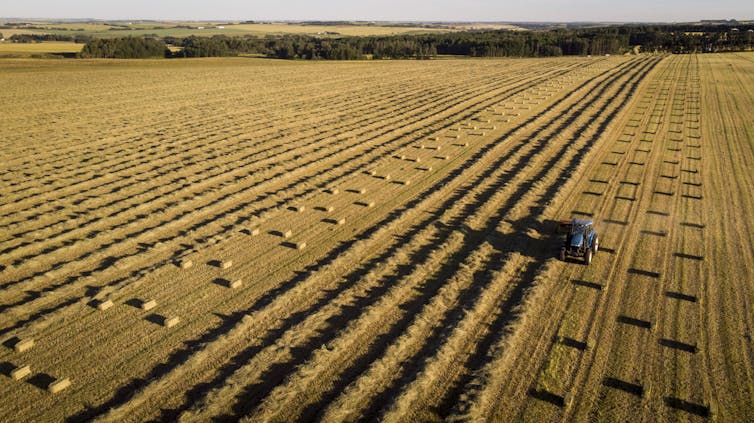 A farmer harvests hay on a farm near Cremona, Alta in August 2020. THE CANADIAN PRESS / Jeff McIntosh
To examine the historical effectiveness of Canada’s real estate and farmland as investment hedge, I compared inflation to the new house price index and farmland values from 2000 to 2020.
I chose the new property price index as a proxy for property appreciation because it is the most up-to-date indicator of changes in residential property values. The farmland values obtained from Farm Credit Canada were used to determine the appreciation in value.
From 2000 to 2020, the cumulative change in inflation was 39 percent compared to a change and increase in the new property price index of 51.8 percent. The data showed that the new property price index was above inflation.
The story continues under the advertisement
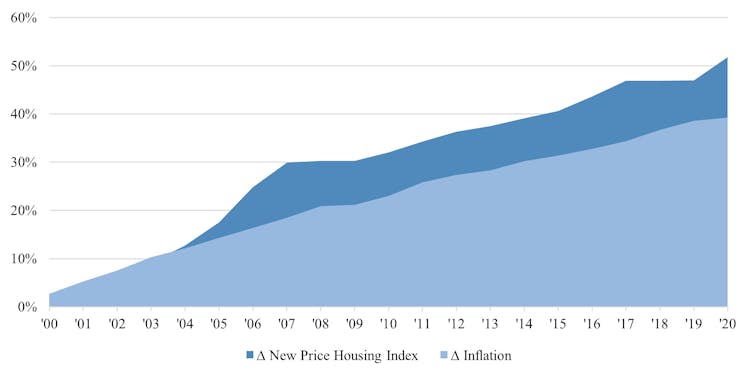 Cumulative change in inflation and the new property price index. (Statista, Statistics Canada), Author provided
From 2000 to 2020, the cumulative increase in the value of arable land was 168.4 percent. The data showed that Canadian farmland significantly outperformed inflation.
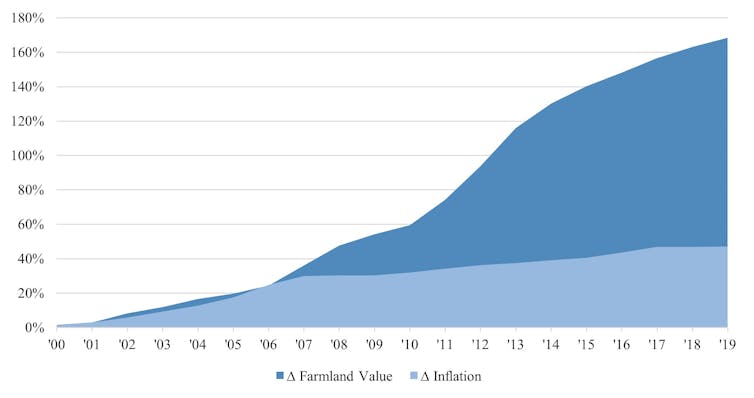 Cumulative change in inflation and arable land value. (Statista, Farm Credits Canada, author’s calculations), Author provided
Based on this 20 year period, it is evident that residential property and farmland values have risen faster than inflation, suggesting that both were effective inflation hedges.
The story continues under the advertisement
Accordingly, savvy investors are expanding their real estate portfolios considerably in anticipation of a period of inflation. Although rising prices, let alone investments, can never be fully anticipated, the most popular predictor of the future is the past.
Macroeconomic trends, including the COVID-19 stimulus package, expected GDP growth and expected unemployment decline, suggest that inflation is on the horizon in Canada.
In these extremely uncertain times, prudent investors seek to protect the value of their money. So far, Canadian residential real estate and farmland have proven to be a strategic hedge against inflation.
Finally, billionaire industrialist Andrew Carnegie once stated: “Ninety percent of all millionaires do so through owning real estate. Real estate made more money than all industrial investments combined. “
Grant Alexander Wilson, Faculty Member, Department of Management and Marketing, Edwards School of Business, University of Saskatchewan.
This article is republished by The Conversation under a Creative Commons license. Read the original article.
Show link »