Despite rising interest rates, inflation Baton Rouge real estate market expected to remain healthy | Business
Despite rising interest rates and surging inflation, experts say the outlook for the Baton Rouge real estate market in 2022 is bright.
The local residential, industrial, multi-family and retail markets are expected to remain strong in the upcoming year, according to speakers at Thursday’s Trends in Real Estate conference. And even though the Federal Reserve is expected to increase interest rates several times in the upcoming years, rates will still be fairly low, historically speaking.
“The market is cooling off a little bit from the past two years,” said Tom Cook, an appraiser with Cook, Moore, Davenport & Associates. “But if something goes from being 1,000 degrees to 500 degrees, you can say it’s cooling off. We’re cooling off from red hot.”
During 2021, demand was so great for homes that in busy areas such as Livingston Parish, houses were being sold before they were actually listed as being for sale, Cook said. The median number of days a house was dropped on the market before it sold from 34 days in 2019 to 7 days in 2021.
Several factors caused the demand — millennials moving into their own homes, people having more money to buy a home because of the money they saved during the COVID pandemic and the government assistance that was provided, and wealth being transferred from family members who died during the pandemic. But Cook said the biggest factor was the low interest rates.
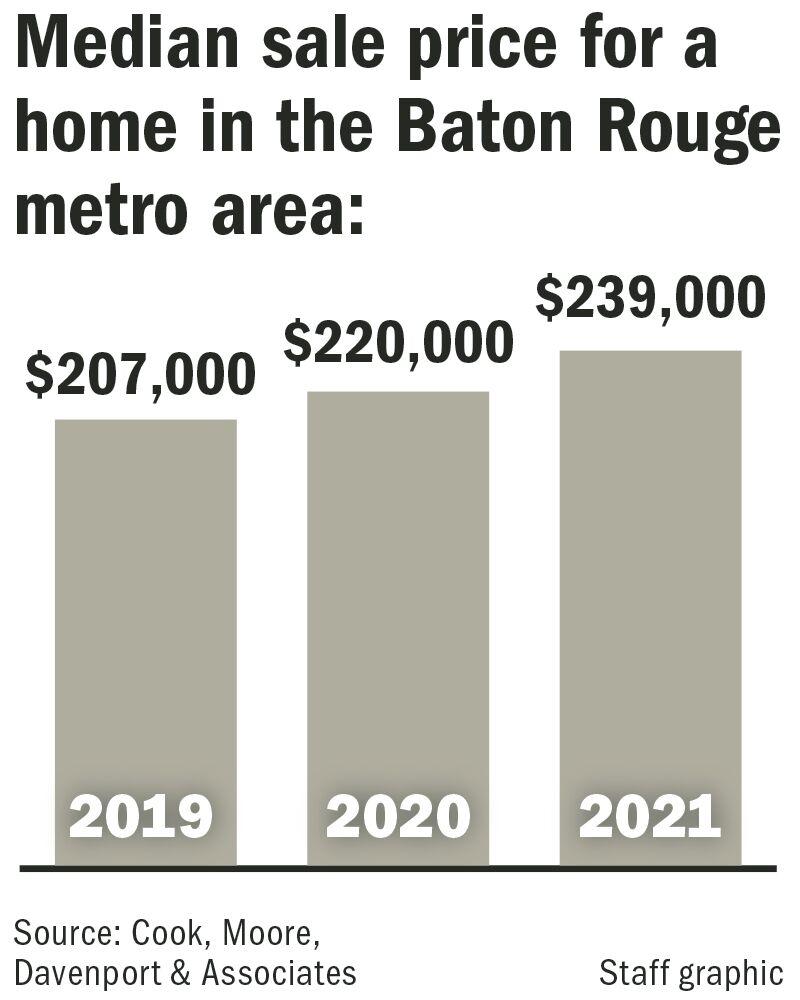
With 30-year mortgage rates hovering around 3% during 2021, that meant to get a $300,000 mortgage, an income of $45,000 was required to qualify, Cook said. That comes to a monthly note of $1,265. About 135,000 households in metro Baton Rouge have annual incomes between $42,000 to $150,000 a year.
If mortgage rates go up to 6% this year, that means in order to qualify for the same $300,000 mortgage on a median priced home, an annual household income of $62,000 will be required, Cook said. That potentially means about 100,000 potential buyers, or 25% less would qualify.
In response to the rising home costs and interest rates, Cook said he expects more builders to start constructing townhomes this year, smaller residences in the $175,000 to $225,000.
Limited inventory has been an issue in the industrial market, which has been strong because of demand for warehouse space, said Evan Scroggs of NAI/Latter & Blum. The vacancy rate for industrial space locally has dropped from 6.2% at the end of 2019 to 3.1% at the end of 2021.
But Scroggs said industrial space locally is “functionally 100%”, because much of the empty space is obsolete and outdates.
Twice daily we’ll send you the day’s biggest headlines. Sign up today.
“Having that sort of hyper-low vacancy rate means tenants from outside can’t move in the market,” he said. Unlike markets such as Dallas, Houston and Atlanta, there aren’t national firms looking to build speculative industrial developments of 250,000 square feet or more. The industrial developers building spec warehouse space here are doing projects in the 15,000 to 25,000 square foot range.
“We’re out of sight, out of mind,” Scroggs said.
While rising interest rates and high gas prices are something to worry about, Charlie Colvin of Momentum Commercial Real Estate said he expects the retail market to remain healthy.
“There’s been a lot of interest from restaurants, automotive businesses, fitness centers,” he said – all items that can’t really be sold online. The retail vacancy rate dropped from 10.5% to 8.8% in 2021, which Colvin said is a sign of health.
Even the fact that Towne Center plans to demolish a building that had been occupied by Books-A-Million and replace it with a 286-unit upscale apartment development is a good sign, Colvin said. Towne Center is using the proximity to retailers and restaurants, such as Whole Foods, PF Chang’s, Nike and Walk-On’s Bistreaux & Bar as selling points for apartment tenants.
Craig Davenport of Cook, Moore, Davenport & Associates said after several years of flat growth, the apartment market picked up in 2021. Rental rates jumped up 9.4% from 2020 and vacancy rates plunged from 10.4% to 4.8%.
Several factors have propelled this growth: low vacancy rates in areas such as Ascension Parish, LSU increasing enrollment and going back to in-person classes.
The favorable numbers attracted the attention of out-of-state investors. Before 2021, one non-LSU area apartment complex sold for more than $190,000 a unit. Last year, there were eight deals that exceeded that mark and 12 apartment developments that sold for more than $24 million.
While rising interest rates and construction costs are expected to cool the market slightly, Davenport said there are still good signs.
“There’s a lot of money chasing deals,” he said.
The Trends seminar started in 1988 as a joint project of the commercial and investment division and LSU’s Real Estate Research Institute. The goal of the program is to educate members of the division, their clients and other real estate practitioners in the greater Baton Rouge area about what is going on in the local market.