Mini-Budget sends shivers through commercial property
- Reits and housebuilder share prices plummet
- Mortgages withdrawn from the market
It’s tough time for real estate investment trusts (Rits) and housebuilders. In reaction to chancellor Kwasi Kwarteng’s disastrous “mini” budget, Independent Living Reit has abandoned a planned £150mn IPO, LXi Riding (LXI) binned his plans to buy a £500mn supermarket portfolio, and share prices in property companies slumped across the board.
While the listed property sector has seen some value recovery since, the medium-term outlook remains gloomy. The sector is worried about what the toxic mix of rising applies yields, high interest rates and a falling pound will mean for both commercial and residential assets – and they have good reason to be.
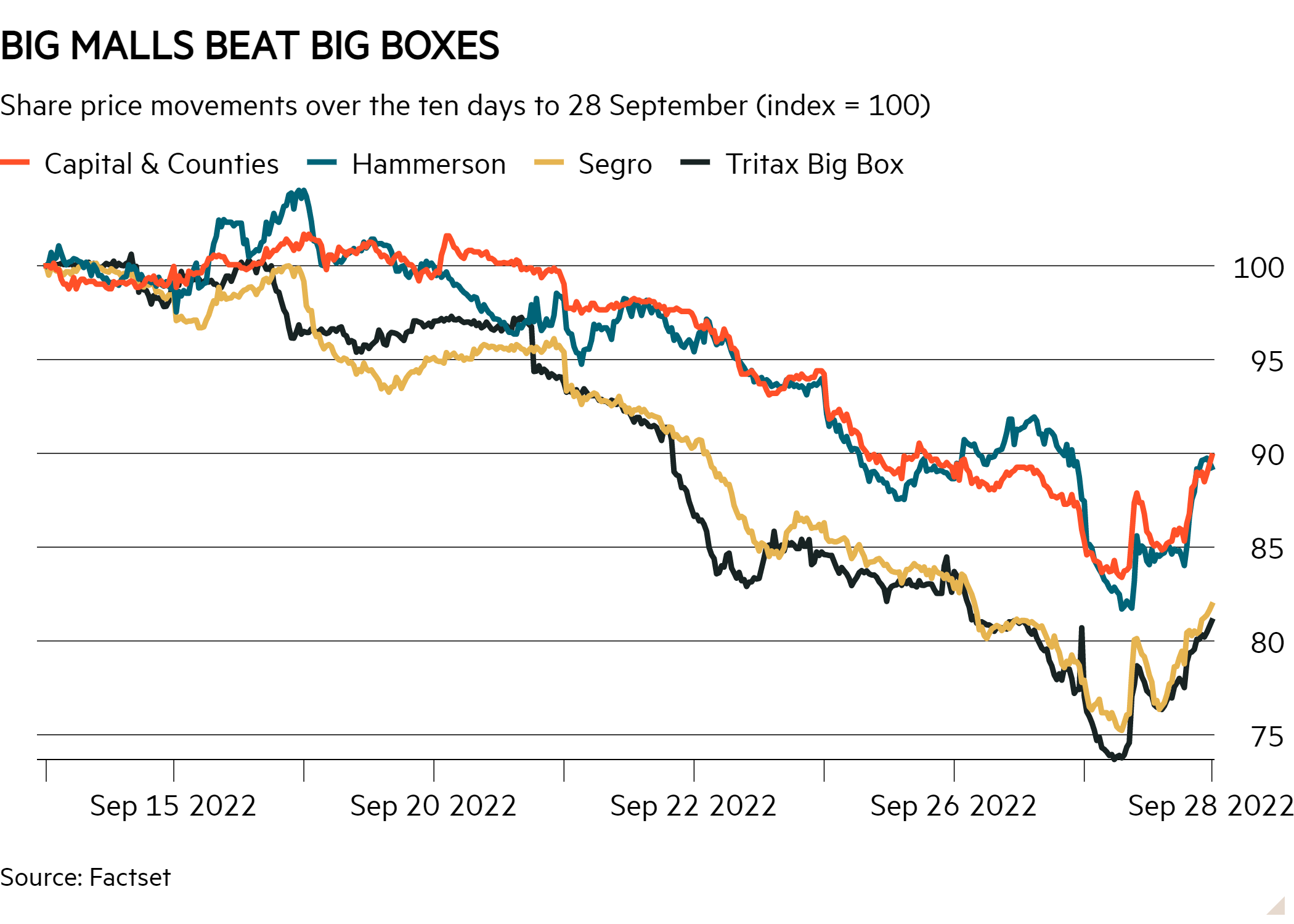
Reits holding low-yielding warehouses have been hit hardest by the spike in gilt yields brought on by Kwarteng’s fiscal statement. For years, funds of all kinds have been desperate to get exposure to a sector which has been recording record levels of leasing due to the rising popularity of online shopping, sending average yields down to record lows.
Yields have increased over recent weeks as some of the shine has come off the sector. But with applicable yields now hovering above 4 per cent, versus the average investment yield of the warehouse market of 3.5 per cent at the start of September, those same assets have begun to look overvalued. Rising interest rates and a potential slowdown in online shopping brought on by a fall in consumer confidence also pose a big problem for the warehouse developers going forward.
Reits with high-yielding properties – a sign of risk in ordinary times – also fell in reaction to the gilt yield jump, but by proportionately less. Shopping center landlords like Hammerson (HMSO) and retail landlords like Capital & Counties (CAPC) have been pariahs of the sector for a long time due to the well-chronicled struggles of physical retail but, with gilt yields rising, equity investors want Reits with the ability to generate greater returns on their assets. As such, faced with the choice between weak asset value growth and taking a punt on the notion that retail values have bottomed out, some investors have opted for the punt.
On the one hand, they could be right. Internet shopping penetration looks like it may have peaked, average vacancy rates may also have reached their zenith, investment in retail assets looks like it may be recovering from its late 2020 nadir, and retail rents have dropped to a level where physical real estate actually looks attractive to some retailers. But if rising interest rates and a recession causes even more pain for physical shops, these bets could easily prove to be spectacularly wrong.
Housebuilders also suffered a sell off in reaction to the mini-budget, although yields are less of a factor here. The nervousness here centers on the housing market itself, which is now looking much more likely to face a downturn. Worries that the stamp duty discount would send the market back into overdrive – as it did in 2020 during after the last stamp duty discount – now seem like a distant memory, as the fear of ever greater interest rate increases not saw banks remove thousands of mortgages offers from the market, but also scares away buyers. Some banks have since reintroduced those mortgages, but the mood music is clear: prospective home buyers are fearful of purchasing anything right now and many would struggle to get a loan even if they wanted to.
Read more: Housebuilders: too late to sell, too soon to buy.
With remortgaging affordability also in the spotlight, Capital Economics is predicting a house price fall of up to 15 per cent next year while other economists see drops of 20 per cent. These sorts of predictions may turn out to be overly pessimistic, but even before the budget mayhem Savills was predicting a 1 per cent fall in house prices next year. Whatever happens, a slowdown of some sort looks inevitable.
Meanwhile, the jury is still out on the prospects of transactional activity in the commercial real estate market. LXI’s deal was binned, but Landsec’s (LAND) decision to sell a prime £809mn City office building to Lend Lease (AU:LLC) still went ahead – albeit at a 9 per cent discount. So too did Supermarket Income Reit’s (SUPR) purchase of a Tesco (TSCO) supermarket in Bradley Stoke, Bristol, for £84mn.
Both the Landsec and the Supermarket Income deals show where the listed real estate market is headed. The former was done as part of a multi-billion sell-off strategy, designed to chase greater returns through selling ‘safer’ low-yielding assets and buying riskier high-yielding assets where they can add value through redevelopment and refurbishment. Meanwhile, Supermarket Income’s deal was done at a 5.6 per cent yield – much higher than the average supermarket deal of recent times. In other words, even before the gilt yield spike caused equity investors to sell off shares in the lower-yielding Reits, listed property companies have been pushed by the market to find greater returns through the higher risk ‘value-add’ opportunities.
However, that is much harder to do when interest rates on debt are increasing and equity raising becomes less attractive due to your falling share price. Landsec’s solution has been to sell assets to raise cash, but not every Reit has that luxury. Rather, many have assets which they can’t afford to sell and debt piles which – though far from unreasonable when interest rates were more stable – now looks questionable. By contrast, many housebuilders are swimming in cash, giving them more of a cushion to soften any house price fall.
|
RISKY REITS, SAFE AS HOUSES? NET DEBT AND CASH POSITIONS |
|
|
company name |
Net debt/net cash |
|
Landsec |
55 percent debt to net assets |
|
hammerson |
52 percent debt to net assets |
|
British country |
38 percent debt to net assets |
|
Segro |
26 percent debt to net assets |
|
Berkeley |
£263m in net cash |
|
persimmon |
£782m in net cash |
|
Barratt Developments |
£1.1bn in net cash |
In addition to all of this, a recession would mean business failures and in turn a fall in rents, which clearly makes things even more challenging for commercial landlords. As Marcus Phayre-Mudge, fund manager of the property securities-focused TR Property Investment Trust (TRY), summed up to Investors Chronicle last month, “there is “a very strong correlation between employment growth and rents. So, if we go into a recession, rents will fall”. Reits and housebuilders alike have no easy options.