Press Release: Real Estate Forecast 2023
ULI and PwC Release Annual Emerging Trends in Real Estate® 2023; Leaders shared how New and Planned Investments will Shape the Region at ULI’s Annual Real Estate Forecast
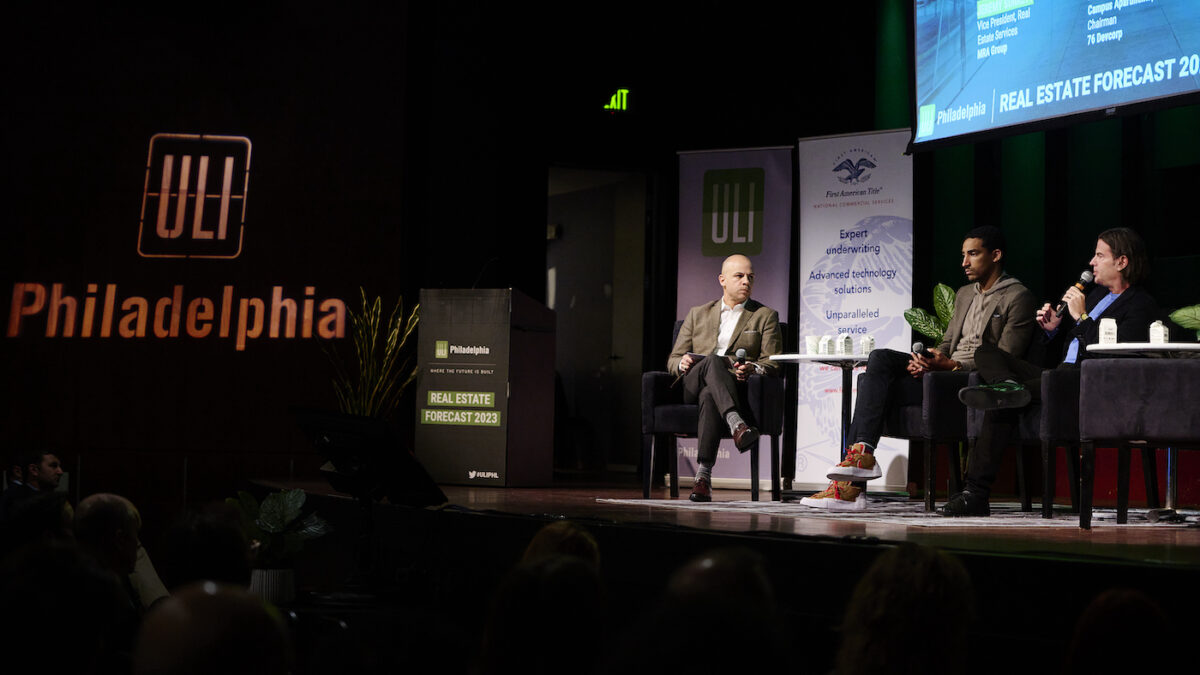
Hundreds of real estate and planning leaders convened at the 23rd Annual ULI Philadelphia Real Estate Forecast: Exploring Drivers of New Investment in Our Region
On November 15th, ULI members and industry professionals met in person and virtually to discuss and explore new investment in the region, identify key regional drivers leading to that new investment, and how Philadelphia is positioned among national trends detailed in the Emerging Trends in Real Estate ® 2023 report released by ULI and PwC this October.
Key local leaders from multiple sectors discussed how diversity, equity, and inclusion (DEI), and impact initiatives are driving change in real estate development; the continued need for investment in the region’s infrastructure; affordability compared to cities like NYC and DC, paired with world class amenities, will be key assets for the region in competing against markets in the mountain west and south; and finally leveraging the people and future workforce that are passionate about the city.
Anne Cummins, Chair of ULI Philadelphia and Chief Operating Officer at Gattuso Development Partners, opened the event highlighting new investments and initiatives in the region that invigorate the urban cores, promote equity and affordability, and create and preserve open spaces, “projects like these highlight the impact all of you have in this room and on zoom, not just on our built environment but on the overall health and well-being of our communities…for many of us, this is not just a profession, it’s a calling.”
To kick off the event, Jeremy Sunkett, Vice President of Real Estate Services for the MRA Group, moderated a fireside chat with David Adelman, President & CEO of Campus Apartments, & Chairman of 76 Devcorp, and David Gould, Chief Diversity and Impact Officer of Harris Blitzer Sports & Entertainment. Their conversation focused on real estate development, DE& I, and impact initiatives.
Adelman and Gould discussed how these initiatives inform their proposed 76 Place project, the new arena for the Philadelphia 76ers. In developing the arena, Gould discussed part of this process is their current engagement with the neighboring community, “we [76 Devcorp] are in active conversations with community stakeholders, there’s going to be a steering committee that’s formed with community groups we’ve been talking to that a representative of businesses, residents, and religious institutions within the community.”
Following the fireside chat, a panel of local experts, moderated by Claire Marrazzo Greenwood, SVP for Economic Competitiveness at the Chamber of Commerce for Greater Philadelphia and Executive Director & CEO for the Council for Growth, discussed the drivers of new investment in our region and how to sustain regional economic growth. Panelists included: Kevin C. Gillen, Ph.D., Senior Research Fellow & Adjunct Professor of Economics at the Lindy Institute for Urban Innovation and Drexel University, Gina Lavery, Senior Vice President with Econsult Solutions, Inc., and Travis McCready, Head of Life Sciences, Industries Americas with JLL.
McCready touched on the changes occurring in the life sciences industry and in places like Philadelphia, “research universities taking a more active role in building commercial life sciences developments… [that are] mixed-use, dense, exciting environments,” leading to connecting and exchanging ideas. Philadelphia and the region’s unique assets of people, quality of life, and history, were constant themes in the conversation. To leverage these strengths, collaboration between companies and organizations, between city leaders and the state, and continued investment in transit will be key to future economic growth.
The event concluded with Bill Staffieri, Partner, PWC, presenting the findings of the Emerging Trends in Real Estate 2023 Report. Staffieri noted “the top theme of the 2023 outlook is taking the long view…near term concerns that are offset by the long-term optimism in the industry.”
Locally, Philadelphia continues to have a stable outlook. The near-term concerns of when workers will return to the central business district, migration patterns of residents who work outside of the city, and aging infrastructure, are offset by favorable outlooks for the city, including its diverse economy and redevelopment opportunities.
The Emerging Trends report noted, “currently, the economy is being defined by rising interest rates and uncertainty over future market conditions. However, most of the real estate professionals interviewed for this report are cautiously optimistic about the longer-term prospects for the industry.”
Trends highlighted in the report include the following:
- Normalizing: Defying about every prediction voiced during the terrifying and uncertain days of the COVID lockdown, US commercial property markets subsequently embarked on a remarkable run, with some of the strongest returns, rent growth, and price appreciation rates ever recorded. Now, more than two years later, property investors and managers are learning that enormous growth and profits eventually fall back to earth.
- . . . Still, We’ve Changed Some: Even as some property markets begin to “normalize” in many ways, we will not be resuming our former lives in some key respects. Many activities—and how we use space—seem unlikely to return to the old ways, influencing shopping, business travel, and office space.
- Too Much for Too Many: Housing is too expensive. It has been that way for too long—for too many people neither for-sale nor rental housing is affordable—but prices and rents have soared even further out of reach over the course of the past year. And even if we experience an economic downturn, as many economists expect, it is not projected to provide significant relief.
- Smarter, Fairer Cities through Infrastructure Spending: Infrastructure is back among the top trends in Emerging Trends, but this time on a more hopeful note. New federal infrastructure spending provides the opportunity to replace and expand critical urban infrastructure to rebuild cities and spur new development—and address historical inequities.
- Climate Change’s Growing Impact on Real Estate: The earth is getting hotter. As a result, extreme weather and climate events are becoming more frequent and more severe. NOAA’s National Centers for Environmental Information calculates that the annual number of billion-dollar events (adjusted for inflation) in the United States has been increasing rapidly in recent decades, rising from about three per year in the 1980s to over 20 in the 2020s. This year, we highlight climate’s impact on us as owners, managers, and users of real property—and how our industry can proactively address the impacts of climate change on our assets.
###
About ULI Philadelphia
The Urban Land Institute (ULI) is a nonprofit education and research institute whose mission is to shape the future of the built environment for transformative impact in communities worldwide. Established in 1936, ULI today has more than 45,000 members around the globe representing the entire spectrum of land use and development disciplines. The Philadelphia District Council (ULI Philadelphia) includes nearly 900 members throughout the Philadelphia metro, Central Pennsylvania, the Lehigh Valley, Southern New Jersey, and Delaware. For more information, please visit philadelphia.uli.org.
About Emerging Trends in Real Estate ®
Emerging Trends in Real Estate® is a trends and forecast publication now in its 44th edition, and is one of the most highly regarded and widely read forecast reports in the real estate industry. Emerging Trends in Real Estate® 2023, undertaken jointly by PwC and the Urban Land Institute, provides an outlook on real estate investment and development trends, real estate finance and capital markets, property sectors, metropolitan areas, and other real estate issues throughout the United States and Canada.