Saudi Real Estate Investors One-Year Losses Still 33%, Even After 4.5% Gain Last Week
Passive investing in an index fund is a good way to ensure your own returns roughly match the overall market. Active investors aim to buy stocks that vastly outperform the market – but in the process, they risk under-performance. That downside risk was realized by Saudi Real Estate Company (TADAWUL:4020) shareholders over the last year, as the share price declined 41%. That falls noticeably short of the market decline of around 0.6%. At least the damage isn’t so bad if you look at the last three years, since the stock is down 14% in that time.
While the stock has risen 4.5% in the past week but long term shareholders are still in the red, let’s see what the fundamentals can tell us.
View our latest analysis for Saudi Real Estate
While the efficient markets hypothesis continues to be taught by some, it has been proven that markets are over-reactive dynamic systems, and investors are not always rational. One flawed but reasonable way to assess how sentiment around a company has changed is to compare the earnings per share (EPS) with the share price.
During the last year Saudi Real Estate grew its earnings per share, moving from a loss to a profit.
Earnings per share growth rates aren’t particularly useful for comparing with the share price, when a company has moved from loss to profit. So it makes sense to check out some other factors.
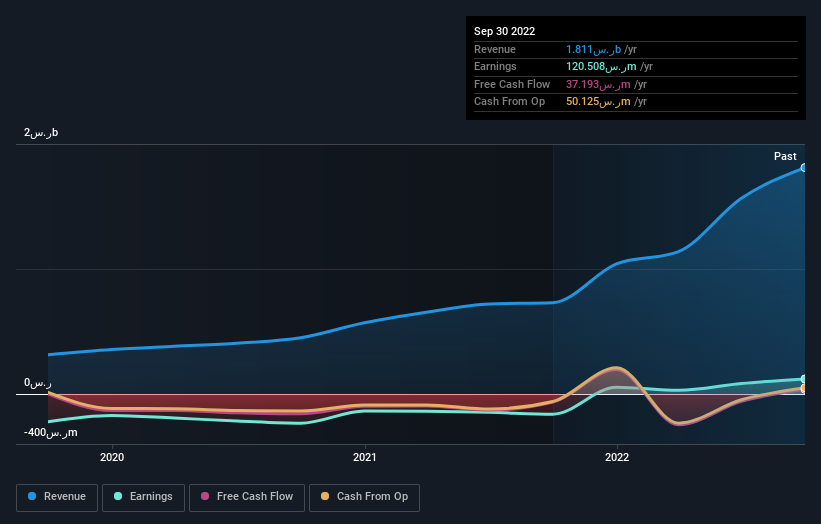
Saudi Real Estate’s revenue is actually up 148% over the last year. Since the fundamental metrics don’t readily explain the share price drop, there might be an opportunity if the market has overreacted.
You can see below how earnings and revenue have changed over time (discover the exact values by clicking on the image).
SASE:4020 Earnings and Revenue Growth January 9th 2023
Balance sheet strength is crucial. It might be well worth while taking a look at our free report on how its financial position has changed over time.
What About The Total Shareholder Return (TSR)?
Investors should note that there’s a difference between Saudi Real Estate’s total shareholder return (TSR) and its share price change, which we’ve covered above. The TSR is a return calculation that accounts for the value of cash dividends (assuming that any dividend received was reinvested) and the calculated value of any discounted capital raisings and spin-offs. Its history of dividend payouts mean that Saudi Real Estate’s TSR, which was a 33% drop over the last 1 year, was not as bad as the share price return.
A Different Perspective
We regret to report that Saudi Real Estate shareholders are down 33% for the year. Unfortunately, that’s worse than the broader market decline of 0.6%. Having said that, it’s inevitable that some stocks will be oversold in a falling market. The key is to keep your eyes on the fundamental developments. On the bright side, long-term shareholders have made money, with a gain of 4% per year over half a decade. It could be that the recent sell-off is an opportunity, so it may be worth checking the fundamental data for signs of a long-term growth trend. I find it very interesting to look at share price over the long term as a proxy for business performance. But to truly gain insight, we need to consider other information, too. Consider for instance, the ever-present specter of investment risk. We’ve identified 2 warning signs with Saudi Real Estate , and understanding them should be part of your investment process.
Of course, you might find a fantastic investment by looking elsewhere. So take a peek at this free list of companies we expect will grow earnings.
Please note, the market returns quoted in this article reflect the market weighted average returns of stocks that currently trade on SA exchanges.
Valuation is complex, but we’re helping make it simple.
Find out whether Saudi Real Estate is potentially over or undervalued by checking out our comprehensive analysis, which includes fair value estimates, risks and warnings, dividends, insider transactions and financial health.
View the Free Analysis
Have feedback on this article? Concerned about the content? get in touch with us directly. Alternatively, email editorial-team (at) simplywallst.com.
This article by Simply Wall St is general in nature. We provide commentary based on historical data and analyst forecasts only using an unbiased methodology and our articles are not intended to be financial advice. It does not constitute a recommendation to buy or sell any stock, and does not take account of your objectives, or your financial situation. We aim to bring you long-term focused analysis driven by fundamental data. Note that our analysis may not factor in the latest price-sensitive company announcements or qualitative material. Simply Wall St has no position in any stocks mentioned.