PLAN: A 1-Year Marketing Calendar For Brand New Agents
New to the industry? Start with everything you need to know about the early decisions that will shape your career, including choosing a brokerage firm, learning about your market, creating an online presence, budgeting, generating leads, marketing, and more more. If you’re a team leader or a broker owner, New Agent Month is jam-packed with resources to help your new hires get their bearings.
This article is largely from a story previously published on Inman.
The first time you get your real estate license, your mind may be filled with questions of contract drafting, property previewing, and the closing process. However, when you ask about these things, the answer from brokers and coworkers is usually, “Don’t worry about it. Just worry about getting customers. “
While it’s a frustrating answer, it sounds true. Most real estate agents leave properties because of too few customers, not because of an obscure contractual clause. But developing a marketing plan can be difficult for new agents, in part because it is difficult to sell yourself when you have so little hands-on experience.
But everyone has to start somewhere, so here is a schedule to walk you through your first year as a real estate agent.
Month 1
1. Get headshots
Get professional headshots for personalized business cards, websites and social media marketing. Your brokerage business may have opportunities to do so from time to time, or you can google “headshots near me” and check the galleries of local photographers to see which style you like best.
Don’t let the old blazer and twisted look limit you. Many agents choose a more relaxed, approachable look for their headshots.
2. Order business cards
If your broker doesn’t provide them, order business cards with your new headshot and your preferred phone number and email address. Do not order a large number of these or order the most expensive ones you can find.
Over the next few months, you will no doubt be replacing them, adding social media accounts, or making other changes. Just look for a decent, affordable card and make sure you provide the information required by your state’s laws and brokerage policies.
3. Develop your sphere
Start developing your sphere of influence by collecting the postal addresses, email addresses, and phone numbers of everyone you know – friends, family, acquaintances, church members, neighbors, and more.
This will form the basis for your initial marketing, but you will need to keep adding to this list – daily if possible.
4. Organize your contacts
Create a table to organize the contact information for your sphere. At first, you might want to save it in Excel or Google Sheets, but eventually you’ll want to purchase a customer relationship management (CRM) software subscription to make it easier for you to communicate with your list.
5. Reach your sphere
Reach out to everyone on your list this month, preferably through a handwritten note with one or two of your business cards in it. Don’t be shy – let them know you are licensed and that you appreciate their recommendations.
Call to discuss and ask if they know anyone who is thinking of buying or selling real estate.
Month 2
1. Continue adding to your list
Andrey Nokhrin, CEO of FLIPT, said, “Agents should devote their time and resources to aggressive prospecting and marketing. Ideally, your pipeline should have at least 1,000 potential customers to market to. “
You probably won’t have 1,000 friends on your list right now, so start by creating monthly goals to help you achieve that goal. Participate in and create networking opportunities, participate in lead generation activities through your brokerage, and focus on feeding that database.
2. Build your website and your social media presence
If you didn’t do this when you onboarded, create a personal website and social media accounts for your business. Pick a set to use across all of your accounts to link them together.
No URL under your name, no Facebook account under your city, and no Twitter handle under any other term. Make sure you have consistent names, logos, colors, and images so that people you find on Twitter go to your website and know they are in the right place.
3. Create a schedule for social media posting
You will be tempted to go overboard and post obsessively in order to increase your followers and likes. A schedule will help you control that impulse and post it consistently and steadily without wasting all of your time.
- For Facebook: Post once a day
- For Twitter: Post once or twice a day, retweet or quote tweet five to ten times a day
- For Instagram: Post once a day
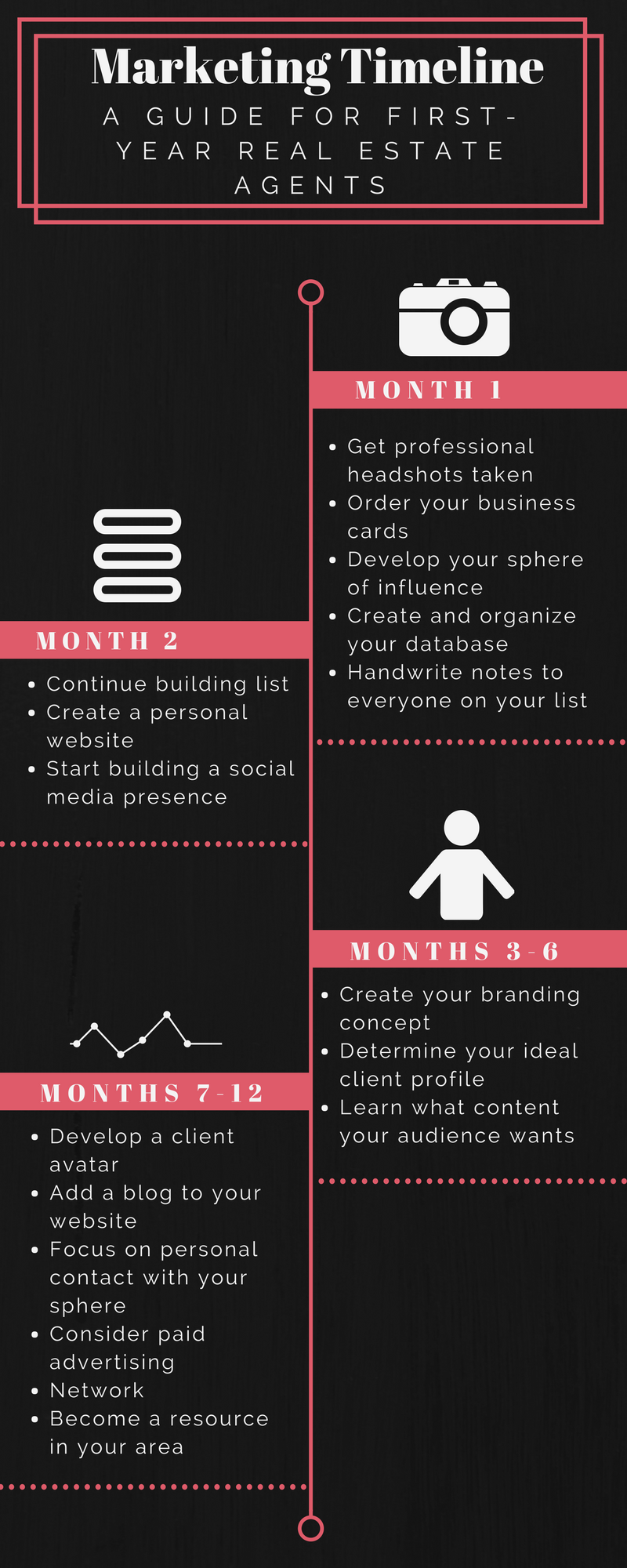
Months 3-6
1. Refine your branding concept
Now that you have a basic setup, audience to talk to, and a bit of experience, it’s time to start developing a branding concept.
Although this can include visual elements like logos, fonts, or signature colors, the main purpose is to help you position yourself in your market and find a focus for your marketing message.
2. Identify your ideal customer
Use your personal and social connections to determine who your ideal customer should be.
Nokhrin said, “If your background has given you a unique network, such as military families, job relocations or first-time home buyers, use online marketing and social media to grow faster and reach out both inside and outside of these communities. This allows you to build a sales pipeline faster and more cost-effectively than with conventional marketing methods. “
3. Communicate with your audience
Wondering what to say to your audience? Think of Gary Vaynerchuk’s formula: Jab, Jab, Jab, Right Hook. This means sharing meaningful, valuable information with your audience several times before asking them about their business. This way you are coming from a place of service rather than a place of sale.
Also, think of Stacey Cohen’s 3 W’s for great branding:
- WIFM (What’s In It For Me?) To address the client’s pain points
- Pass the “Who cares?” Test by finding out how you can add value
- Take the wow factor into account when figuring out what to do that no one else in your field can do
Months 7-12
Now is the time to refine and build on the marketing you did for the first six months as an agent.
You probably have a few customers under your belt, and you probably better understand what you love and what you don’t, what you’re good at and what you’re struggling with, and you can better understand what you’re bringing to the prospect table.
1. Develop a client avatar
This is how you can determine who your ideal customer is. Then refine your online and social media marketing to better target the ideal customer. Determine demographic information like gender, age, and potential price range. Even favorite brands, shows, and other details can help you flesh out the avatar and market it more effectively.
2. Start blogging
If you have a talent for writing, consider adding a blog to your website. Bi-monthly blog posts can help you highlight your market knowledge, educate potential buyers and sellers, make suggestions, or just showcase your personality and passion for real estate.
When you start collecting a number of posts, these can also form the basis of your social media marketing plan to promote your services across platforms.
3. Create video content
If you enjoy working with video, spend some time developing video content to primarily communicate your services and expertise.
You don’t need sophisticated production values to create meaningful video content. Grab your phone and film yourself on the go in your favorite area or near a recognizable landmark. Let people know what it is like to live in your city – and how you can help them meet their real estate goals.
4. Focus on personalized communication
Since you’ve spent several months working on your list, you should have a pretty solid collection of names and contact information. “Today an agent needs at least seven to 20 marketing contacts before a prospect decides to talk to you,” said Nokhrin. “If there are more than 1,000 potential customers in the pipeline, you cannot reach everyone personally.”
He continued, “Pick the top 10 percent on the list to focus on personal endeavors like calling or texting while regularly sending out automated CMAs and market reports to everyone else.”
5. Consider paid advertising
If your list is still a little thin, it may be time to consider paid service, direct mail, or paid social media advertising to collect from prospects.
When considering paid leads, focus on long-term ROI to see if this is an efficient use of your marketing budget.
Track the amount you spend on marketing and compare it to conversions and commissions earned. While they may not bring you a customer right away, they are worth the money if they are generating more income than you spend over the course of a year and adding additional leads to your pipeline for longer-term conversion efforts.
6. Partnership with local media
If you’ve networked successfully in your area, you may have come into contact with bloggers or reporters to collaborate with local media and online mentions. Create a regular column for the local newspaper or provide guest blogging services for a popular local blog.
Offer a two minute property summary for the local radio or television station. This type of exposure can always pay off if featured regularly.
This should provide you with a good foundation for your marketing efforts when you start out in real estate. With consistent effort, you will find that you have systems and processes in place that will grow with you and will continue to pay off throughout your career.
Stay tuned next week for the new agent’s financial plan. And for all of the new agent month’s content, click here.
Christy Murdock is a broker, freelance writer, coach, consultant and owner of Real estate writing. She is also the creator of the online course Creating the Property Description: The step-by-step formula for reluctant property writers. Follow Real Estate Writing on Twitter, Instagram and Youtube.